
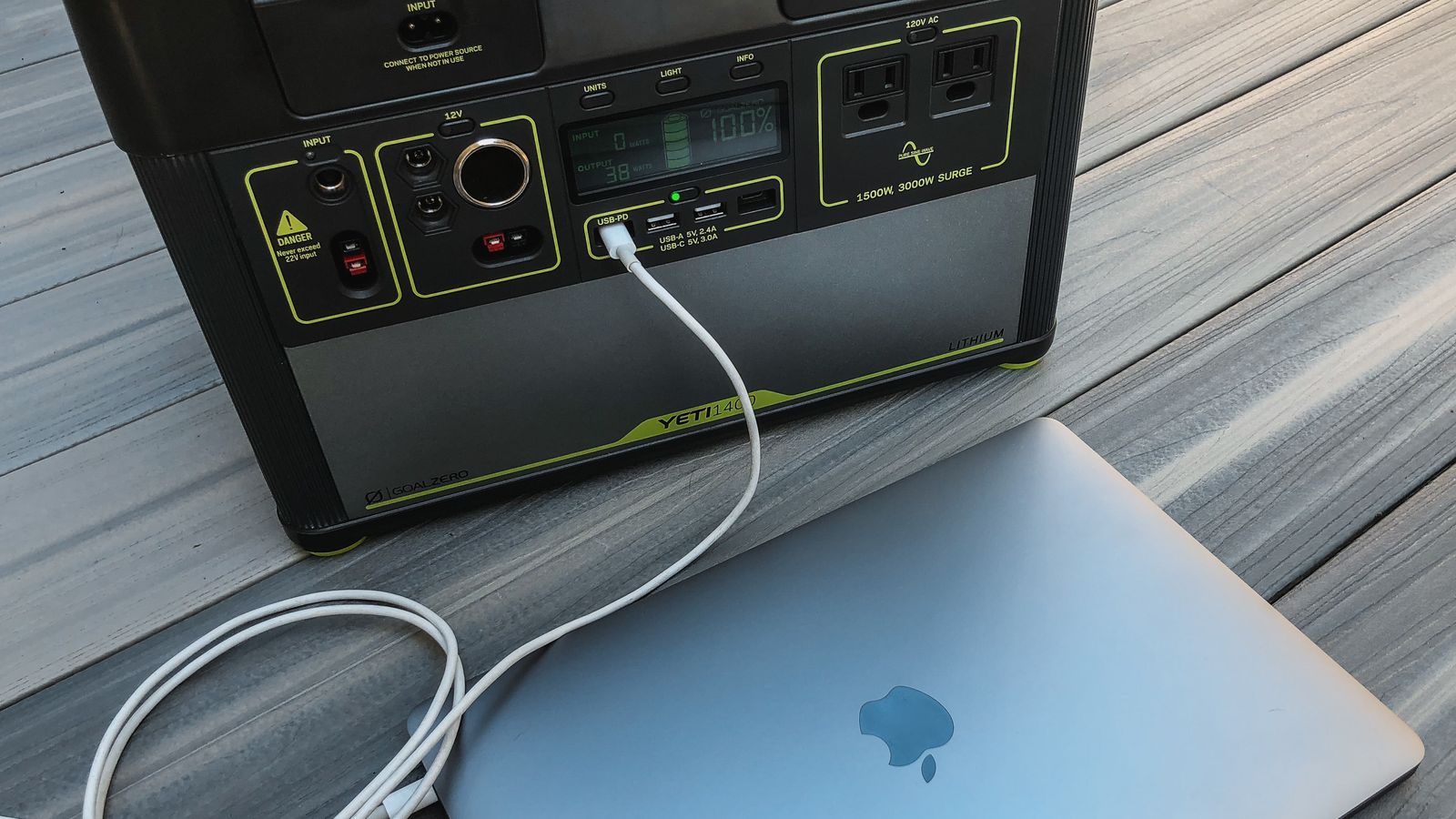
Quick answer: A portable power station can run an appliance if the appliance’s power in watts (W) is below the station’s rated output, and any start-up surge is below its surge or peak rating. How long it runs depends on the battery’s capacity in watt-hours (Wh). As a rough guide, divide the capacity by the appliance’s watts, then allow for some losses. A 1,000Wh station can run a 100W device for several hours, but a 2,000W kettle may be too much for it.
The three numbers that matter
1. Capacity in watt-hours (Wh). This is how much energy the battery stores. A 1,000Wh battery could, in theory, supply 1,000 watts for one hour, or 100 watts for ten hours.
2. Rated output in watts (W). This is the most power the station can supply continuously through its sockets. If your appliance needs more than this, the station will usually shut off or refuse to power it.
3. Surge or peak output (W). Some appliances, especially those with motors or compressors such as fridges, can draw more power for a moment when they start. Makers quote a surge or peak figure for these short bursts.
You can find your appliance’s power on its rating plate, usually a sticker or moulding near the plug or underneath. Look for a figure in W or kW.
A worked method
- Check the watts. Is the appliance’s wattage below the station’s rated output? If not, stop here.
- Check the start-up. If it has a motor or compressor, is the surge rating comfortably above the running wattage?
- Estimate the runtime. Divide the station’s capacity in Wh by the appliance’s watts. That gives an upper limit in hours.
- Allow for losses. Converting battery power to mains-style AC uses some energy, and you may not be able to use every last watt-hour. Expect real runtime to be shorter than the simple sum.
Many appliances do not draw their full rated power all the time. A fridge’s compressor switches on and off, so its average use is lower than its rated watts. Our guide to running a fridge or CPAP overnight explains how to estimate this.
What makers say their stations can run
Jackery’s UK page for the Explorer 1000 v2, which it lists at 1,070Wh capacity and 1,500W output, gives these example runtimes:
| Appliance (Jackery’s wattage) | Jackery’s estimate |
|---|---|
| Microwave (1,160W) | 0.8 hours |
| Weeder (1,100W) | 1.4 hours |
| Electric kettle (600W) | 6 boils |
| Coffee maker (550W) | 1.5 hours |
| Projector (100W) | 8 hours |
| Portable fridge (60W) | 15 hours |
These are the maker’s own figures, which we have not tested. You can see the effect of losses in them. For the 60W portable fridge, the simple sum gives 1,070 divided by 60, which is about 17.8 hours. Jackery’s estimate of 15 hours is about 84% of that.
Note that Jackery’s kettle example is a 600W kettle. Many full-size kettles have a higher rating, so check yours against the station’s rated output.
Rated output: why a 1,000Wh station may not run your kettle
Capacity and output are different things. A station can store plenty of energy but still be unable to supply it fast enough for a high-power appliance.
On 19 October 2026, makers listed these figures for three popular stations of similar size on their UK sites:
| Station | Capacity | Rated AC output | Surge or peak, as listed |
|---|---|---|---|
| Jackery Explorer 1000 v2 | 1,070Wh | 1,500W | Not stated in the page text we checked |
| EcoFlow DELTA 3 Plus | 1,024Wh | 1,800W | 3,600W surge |
| BLUETTI Elite 100 V2 | 1,024Wh | 1,800W | 2,700W “Lifting Power” (Bluetti’s term) |
EcoFlow’s spec table lists 2,400W as the maximum device power supported by its X-Boost feature, above the 1,800W rated output. It does not explain on that page how the feature works, so check the maker’s guidance on which appliances it suits before relying on it. Our guide to running a fridge or CPAP overnight works through two common examples.
Good and bad matches
Usually a good match for a 1,000Wh class station:
- phones, tablets and laptops
- routers and a small TV during a power cut
- LED lights
- a camping or portable fridge
- medical devices such as a CPAP machine, if the maker approves it (see our overnight guide)
Often a poor match:
- electric heaters, which draw high power for long periods and drain a battery fast
- full-size kettles, ovens and hairdryers, which may exceed the rated output
- anything you need to run for days
Recharging
How quickly you can refill the battery matters as much as capacity. Makers list mains, car and solar charging times. For example, EcoFlow says the DELTA 3 Plus charges from 0 to 100% in 56 minutes on mains, and Jackery says the Explorer 1000 v2 takes 1.7 hours on standard mains charging. Solar charging depends on panel size and the weather. For background on solar, see our solar and batteries hub.
What it costs to recharge
Filling a 1,000Wh battery from flat uses about 1kWh, plus charging losses. At the October to December 2026 price cap average of 26.32p per kWh, that is about 26p, before losses. Your own cost depends on your tariff.
Frequently asked questions
What does Wh mean on a power station?
Watt-hours, the amount of energy the battery stores. Divide it by an appliance’s watts for a rough maximum runtime in hours.
Can a power station run my whole house?
Not a portable one. They are designed to run a few devices from their own sockets. Running a home circuit needs specialist equipment fitted by a qualified electrician.
Is a bigger station always better?
Bigger stations run things for longer but are heavier and cost more. Match capacity to what you actually need to run.
Are the makers’ runtimes reliable?
They are estimates. We have not tested them. Use them as a guide and allow a margin.
Sources
- Jackery Explorer 1000 v2, Jackery UK
- EcoFlow DELTA 3 Series, EcoFlow UK
- BLUETTI Elite 100 V2, BLUETTI UK
- Energy price cap unit rates and standing charges, Ofgem
Last checked: 19 October 2026
Image credit: Tony Webster via Wikimedia Commons, CC BY-SA 2.0, cropped.
