Quick answer: Yes. Without a driveway you can use on-street chargers such as lamp-post units, a home charger with a council-approved cross-pavement cable channel, chargers at work, supermarkets and car parks, rapid charging hubs or shared home chargers. A third of the UK’s 121,171 public chargers were on-street on 1 July 2026, according to Department for Transport statistics.
The public network
The Department for Transport’s statistics for 1 July 2026 counted:
- 121,171 public chargers, or 174.9 per 100,000 people
- 28,887 rapid or faster (50kW and above)
- 33% classed as on-street and 52% as destination chargers, such as car parks and hospitality sites
Coverage varies a lot by area. DfT says London has many more public chargers per person than the rest of the UK, but the second-lowest share of rapid ones, because much of its network is standard on-street chargers.
Option 1: on-street and lamp-post chargers
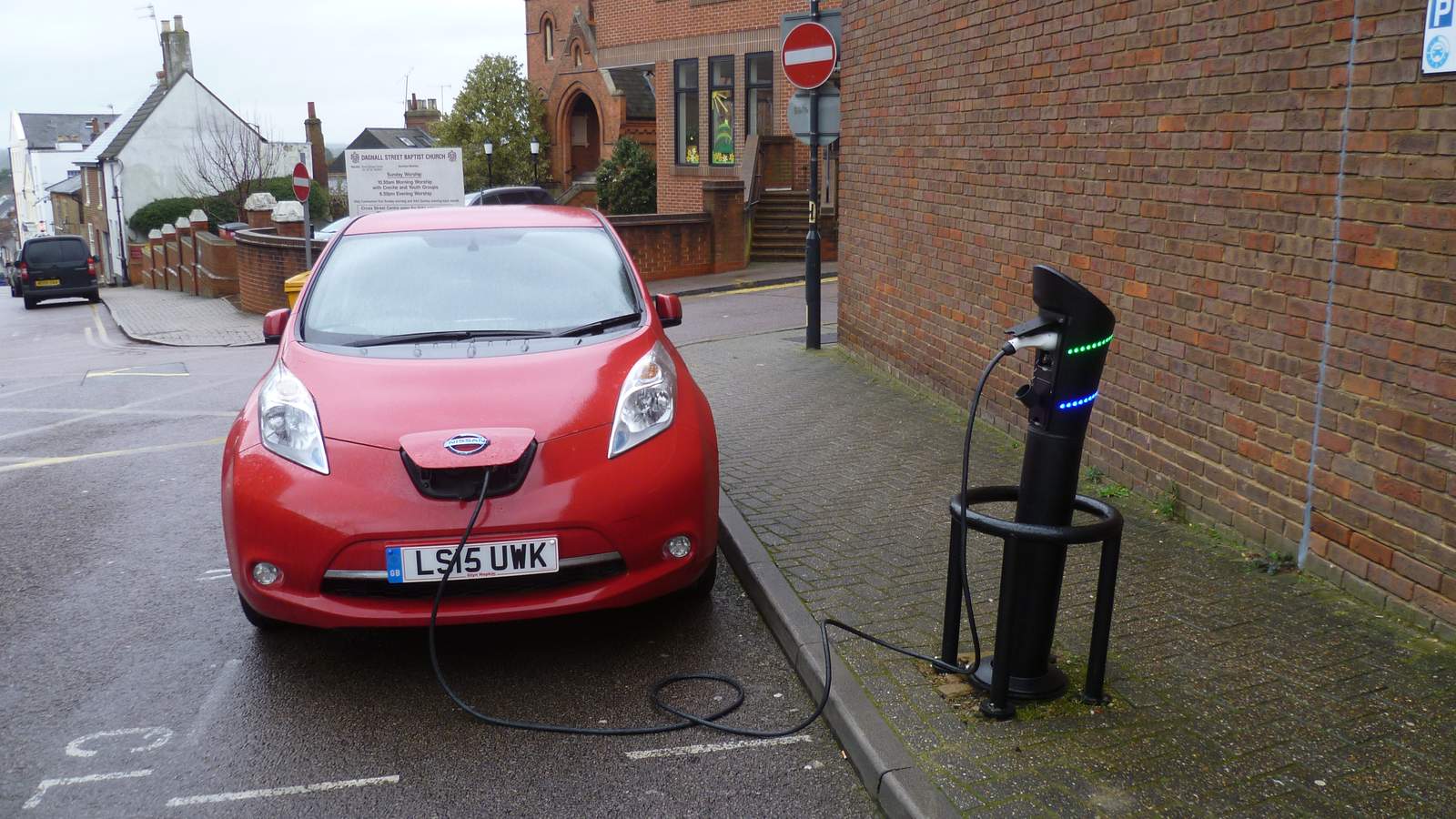
On-street chargers, including units built into lamp posts, are usually slower chargers for residents without off-street parking. These are well suited to overnight charging. Prices vary by council and operator.
In England, the government’s Local Electric Vehicle Infrastructure (LEVI) Fund supports local authorities to plan and deliver charging for residents without off-street parking. Ask your council what is planned for your street, and whether you can request a charger.
Zapmap’s September 2026 average for public chargers under 50kW was 54p per kWh. See public charging costs.
Option 2: a home charger with a cross-pavement solution
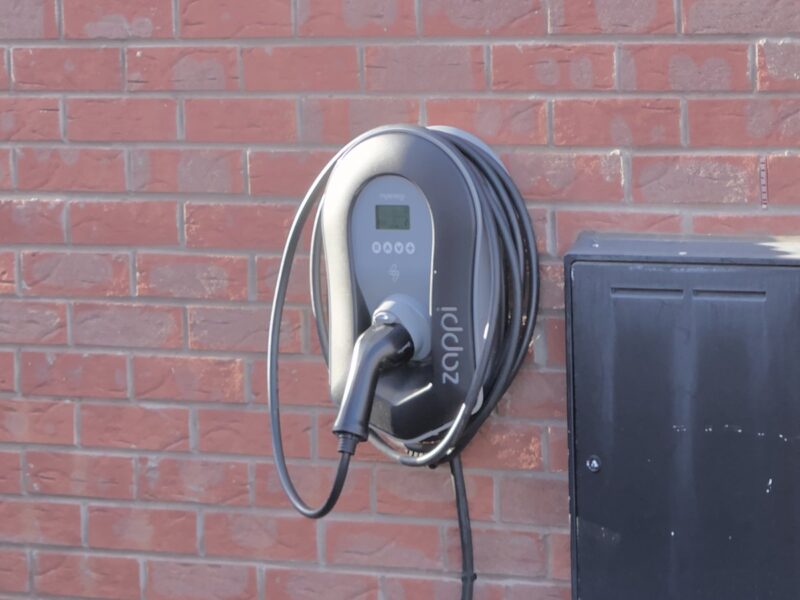
If you can park outside your home, you may be able to fit your own charger and run the cable safely across the pavement. Government guidance on cross-pavement solutions says the decision to allow one rests with the local authority. The most common solution is a cable channel, or gully, set into the pavement, which holds the cable only while charging.
An OZEV grant gives up to £500 towards the charger for households with only on-street parking, until 31 March 2027. Our on-street charging grant guide explains who qualifies and how to get council consent. Never trail a cable across a pavement without permission.
This option lets you use cheap off-peak tariffs. See what home charging costs.
Option 3: charging at work
Ask your employer. Businesses can get up to £500 per socket, for up to 40 sockets, through the government’s Workplace Charging Scheme, available until 31 March 2027.
Option 4: destination chargers
Supermarkets, leisure centres, car parks and hotels often have chargers you can use while you are there. Zapmap’s app lets you filter by speed and connector. Some supermarket networks are among the cheaper rapid options: Zapmap lists Sainsbury’s Smart Charge at 72p per kWh.
Option 5: rapid hubs
Rapid and ultra-rapid hubs can add a lot of range quickly, but cost more: Zapmap’s September 2026 average was 79p per kWh. Zapmap still says drivers who rely entirely on public charging will often be better off than drivers of a comparable petrol or diesel car. Try our EV vs petrol calculator.
Option 6: shared home chargers
The Energy Saving Trust says you can look for shared home chargers, where people in your area share their chargepoints via services such as Co Charger or Zapmap.
Renters and flats with parking
If you rent or live in a flat and have a private parking space, you may get up to £500 towards a charger. See the renters and flats grant.
Choosing the right mix
| Option | Typical cost per kWh | Best for |
|---|---|---|
| Cross-pavement home charger | Your home tariff | Parking outside your home, council consent |
| On-street or lamp-post | Varies; Zapmap average under 50kW: 54p | Overnight charging near home |
| Workplace | Set by employer | Regular commuters |
| Destination | Varies | Topping up while shopping |
| Rapid hub | Zapmap average: 79p | Quick top-ups |
Our charging cost calculator helps compare the costs. The charging hub has more guides.
Frequently asked questions
Can I run an extension lead across the pavement?
No. The Electrical Safety Roundtable says never to use an extension lead for charging, and any cable across the pavement needs council approval.
Can I charge from a 3-pin plug in a flat?
Only with a suitable socket close to your parking space. See charging from a 3-pin plug.
Is owning an EV worth it without home charging?
It can be. See are electric cars worth it.
Related guides and tools
- Hubs: all our electric car guides and charging guides.
- Tools: the charging cost calculator, EV vs petrol cost comparison, eVED calculator and grant checker.
- Also read: How much does public EV charging cost? Latest UK prices and On-street parking? The £500 grant for cross-pavement EV charging.
Sources
- Public electric vehicle charging infrastructure statistics: 1 July 2026, Department for Transport
- Apply for Local EV Infrastructure (LEVI) funding, GOV.UK
- Cross-pavement solutions for charging electric vehicles, GOV.UK
- Electric vehicle chargepoint grants, GOV.UK
- Charging electric vehicles, Energy Saving Trust
- Charging price index, Zapmap
- ESR shares tips for safely using a granny charger, Electrical Safety Roundtable
Last checked: 19 October 2026
Image credit: Philafrenzy via Wikimedia Commons, CC BY-SA 4.0, cropped.